Nicholas W. Darrell:
A First In American Railroad History
- and -
The Historic
South Carolina Canal and Railroad
and the "Best Friend of Charleston"
by James S. Dorrill
[Copyright © 2003 by James S. Dorrill]
Nicholas W. Darrell: First engineer of "The Best Friend"
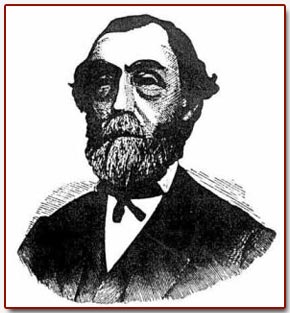
The practicability of establishing a railroad between the city of Charleston, South Carolina, and Hamburg on the western border of the state adjacent to the Savannah River (just across the river from Augusta, Georgia), a distance of 136 miles, was talked of, and even some primary steps taken for its consummation, as early as 1827. A bill in the South Carolina Legislature granting a charter for the South Carolina Canal and Railroad was passed on 19 December that year. Subsequently, the original charter was revised and the final charter was granted six weeks later on 29 January 1828.
Originally chartered as the South Carolina Canal and Railroad, it included additional provisions for a future canal between the Ashley and Savannah Rivers to divert trade from the Savannah River to Charleston. Although a canal was never built, funds were raised for the railroad. The enterprise was not formerly called by the shortened name South Carolina Railroad until 1844, when "Canal" was dropped from the name.
The stockholders of the newly chartered South Carolina Railroad organized as a company on 12 May 1828. One of the first priorities of Horatio Allen, appointed by the organizers as the chief engineer of the contemplated work, was to decide for what power that road should be built. The undertaking was projected to be 136-miles long, and from the character of the countryside, Allen reported, the plan of the road would be naturally influenced by the kind of power adopted.
Preparations for the work were started and the roadway was begun in 1829. Six miles were completed in that year. This initial stretch of track would be the testing ground for not only determining the final construction of the roadway, but just as importantly, the kind of power best suited for the project.
A number of experiments were tried with different methods of power, including even a sailing-car, or a car propelled by the wind. The Charleston Courier reported on one of the test runs of this contraption on 20 March 1830:
"Sailing on land. Wind sails were set on a car on our railroad yesterday afternoon in the presence of a large concourse of spectators. Fifteen gentlemen got on board and flew off at the rate of twelve to fourteen miles an hour. Thirteen persons and three tons of iron were carried about ten miles an hour. The preparations for sailing were very hastily got up, and of course were not the best kind; but owing to this circumstance, the experiment afforded high sport.
The wind blew very fresh from about northeast which, as a sailor would say, was 'abeam', and would drive the car either way with equal speed. When going at the rate of about twelve miles an hour and loaded with fifteen passengers, the mast went by the board, with the sail and rigging attached, carrying with them several of the crew. The wreck was descried by several friendly shipmasters, who kindly rendered assistance in rigging a jury mast, and the car was again soon put under way.
During the afternoon, the wind changed so as to bring it nearly ahead when going in any direction; but this did not stop the sport, as it was ascertained that the car would sail within four points of the winch. We understand it is intended by some of our seamen to rig a car properly, and to exhibit their skill in managing a vessel on land."
From this description, it is apparent that wind-power was not a serious consideration for the South Carolina Railroad. And stationary power was out of the question, Horatio Allen, the chief engineer, reasoned, but some held the opinion that horse-power should at least be considered. Allen submitted a report of his comparative estimate of the results of horse-power and locomotive-power. That estimate was in favor of locomotive-power, Allen admitted, and partly justifying his decision, he later said, "I rested the decision of the question on the position that, what the performance of a horse was and would be, every one knew; but the man was not living who would undertake to say what the locomotive was yet to do."
Calling the locomotive a "great mechanical blessing to mankind," Allen's recommendation was thus in support of locomotive power, and the South Carolina Railroad Company unanimously concurred.
The president of the railroad, Mr. Tupper, in one of his reports to its board of directors, informs them that on 1 March 1830, the committee to whom the matter was referred had reported that they had accepted the offer of E. L. Miller, of Charleston, to construct a locomotive by the West Point Foundry, located at Beach and West Streets in New York City. The specifications required that it should perform at the rate of ten miles per hour and carry three times her weight.
Miller immediately set about the construction of the locomotive. Thus, in the summer of 1830, construction of the South Carolina Railroad Company's first locomotive was begun. It proved to be the first locomotive built in America for actual service. Meanwhile, work on the roadway was pushed forward and another mile completed, making seven miles ready for use, and many more sections under contract and fast approaching completion. The entire 136-mile stretch of track from Charleston to Hamburg was eventually completed by October 1833.
At the West Point Foundry in New York, David Cashew, who was foreman of the workers constructing the locomotive, later writes of the experience:
"The first American-built locomotive for actual service upon a railroad was called the 'Best Friend of Charleston'. I had charge of the hands fitting up this engine; this was in 1830. The locomotive was contracted for by Mr. E. L. Miller, of Charleston. The Best Friend was a four-wheel engine, all four wheels drivers, and two inclined cylinders at an angle, working down on a double crank, inside of the frame, with the wheels outside of the frame, each wheel connecting together outside, with outside rods. The wheels were iron hub, wooden spokes and fellows, with iron tire, and iron web and pins in the wheels to connect the outside rods to.
The boiler was a vertical one, in form of an old-fashioned porter-bottle, with the furnace at the bottom surrounded with water, and all filled inside full of what we called teats, running out from the sides and top, with alternate stays to support the crown of the furnace; the smoke and gas passing out through the sides at several points, into an outside jacket, which had the chimney on it. The boiler sat in the centre of the four wheels, with the connecting-rods running by it to come into the crankshaft.
The cylinders were about six inches in the bore, and sixteen inches stroke. The wheels were about four and a half feet in diameter. The whole machine weighed about four and a half tons. It was shipped to Charleston, South Carolina, on board of the Ship Niagara in October 1830 for the Charleston and Hamburg Railroad, and was put upon that road during the winter."
The "Best Friend" arrived in Charleston aboard the ship 'Niagara' during the night of 22 October or early hours of 23 October 1830. As no machinist from the foundry in New York accompanied the shipment of the locomotive, the superintendent of the railroad employed the services of Thomas Dotterer of the firm Dotterer & Eason, local Charleston machinists and engineers, to assemble the locomotive after its arrival in Charleston, and prepare it for service.
Dotterer & Eason assigned Julius D. Petsch, who was foreman in their workshops, the task of assembling the locomotive. Petsch selected as an assistant, Nicholas W. Darrell, a young man just out of his apprenticeship in their shops. These two men, Petsch and Darrell, immediately set about fitting up the "Best Friend" for the road. Within a few days, all was ready.
After the assembly of the locomotive and up to the 1st of November 1830, several experimental trials, at short distances, were made to see that all was right. On the 2nd of November, with Darrell in charge, along with E. L. Miller accompanied by several other gentlemen on an attached car, another trial run was made. In a letter published the next morning in the Charleston Courier, Horatio Allen describes the eventful trip:
"The public will regret to learn that an accident has happened to a pair of the wheels of the locomotive-engine lately put upon the railroad. To prevent any misunderstanding or exaggeration, it is proper to communicate the facts.
The change of direction which takes place when a carriage enters a curved part of a road is effected by the action of the flange which is attached to the rim against the iron rail. A lateral strain is then brought to act on the spokes of the wheel, and in this present instance they have proved too weak to resist it, and from this circumstance the accident has originated.
The spokes were discovered to spring, thus the forward wheel was sprung inward, so much so as to leave the rail entirely; and the engine, after proceeding about twenty feet, was stopped with both the front wheels off the rail, and some of the spokes much injured.
No personal injury happened to any of the individuals, either on the passenger-car or engine."
And with this trial run of the "Best Friend" on the 2nd of November 1830, with a passenger-car attached carrying passengers, Nicholas W. Darrell was to become a first in American railroad history. Darrell, who was later promoted to Superintendent of Machinery for the South Carolina Railroad Company, thus became the first locomotive engineer on the first American built steam locomotive for actual service.
After the locomotive derailment of November 2nd, the wheels were soon replaced and subsequent trials were made on 14th and 15th December. These trial runs proved the locomotive capable of speeds of sixteen to twenty-one miles per hour with four or five cars containing forty to fifty passengers. Thirty-five miles per hour was obtained with the locomotive running light.
On Christmas day 1830, the "Best Friend of Charleston" made its "formal" debut, and was described by the Charleston Courier on the 29th as "half salamander, half alligator, as he eats fire, breathing steam, and feeds upon light-wood." Said to have 141 passengers, the reporter goes on to write of the trip:
"We flew on the wings of the wind at the varied speed of fifteen to twenty-five miles an hour, annihilating time and space, leaving all the world behind. On our return, in quick and double-quick time, we darted forth like a live rocket, scattering sparks and flames on either side, passed over three salt-water creeks, hop, step, and jump, and landed us all safe before any of us had time to determine whether or not it was prudent to be scared."
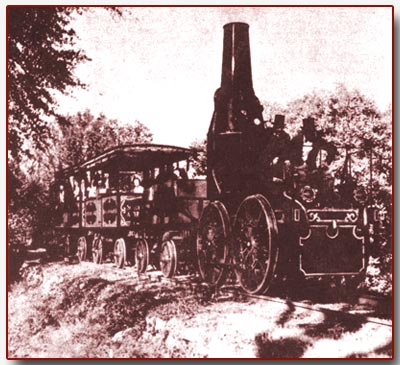
The "Best Friend of Charleston": First locomotive built in America for actual service
The original locomotive on which Nicholas W. Darrell became a first in American railroad history, was accidentally destroyed shortly after it was put in service, just six months into its operation. On Friday the 17th of June 1831, the boiler of the "Best Friend" exploded. This became the first boiler explosion upon a locomotive on record in America.
On that day, the locomotive "Best Friend", with Darrell at the controls, started out on the morning of June 17th to pick up lumber cars, which were waiting to be loaded at the end of the road. At the loading and pick up site, the locomotive was left standing on a revolving platform (a "turntable") which, as this was the end of the completed track, would turn the locomotive allowing it to head back with the loaded flat cars.
Nicholas stepped down from the engine and assisted, or supervised, a Negro laborer in loading the lumber, and left the engine in charge of his Negro fireman. Annoyed by the constant hissing noise of the steam escaping from the safety valve of the boiler, the inexperienced fireman fastened the valve down, thus preventing the surplus steam from escaping, and allowing the boiler pressure to build to dangerous levels.
The boiler burst at the bottom, injuring Darrell the engineer, and the two Negroes; one had his thigh broken and the other received a severe cut in the face and on his chest. Darrell was scalded from the shoulder-blade down his back. None of these injuries were then considered dangerous, except for the broken thigh on the fireman, which later proved to be a fatal injury.
This boiler explosion on the "Best Friend" created somewhat of a controversy at the time, causing questions to be asked about the incident: Why was engineer Darrell not at his post upon the engine, and why was he attending to the loading of the lumber cars, leaving his engine in charge of his Negro fireman?
Looking back now upon those inquiries, it must be remembered that in those very early days of railroad operations, no such positions as conductors, flagmen or brakemen, had been instituted. Thus, the engineer generally had to do their own hitching up, couplings, and other operational duties. Hence the reason why Darrell was not seated on the engine during the arrangement of the train. In those first days and months of railroading, everything had to be learned as the necessity demanded it.
Decades later, in a letter of 2 September 1869, written to author and historian William H. Brown, Nicholas W. Darrell writes of his participation in these historic events, beginning in 1830, "with all the information I can give upon the subject at this distant day, drawn from memory alone, as I have no notes to which to refer." Darrell continues:
"In the spring of 1830, E. L. Miller, of our city, entered into a contract to furnish the South Carolina Railroad with a locomotive. Under this contract Miller brought out his engine, which was built at the West Point Foundry in New York City. The engine arrived by the ship Niagara in Charleston, in the latter part of October 1830. The engine was called the "Best Friend of Charleston".
Julius D. Petsch and myself had served our apprenticeship with Mr. Thomas Dotterer, of the firm of Dotterer & Eason, as machinists and engineers, and were engaged to put this engine together, and made the first run or trial trip. From this date, I was regularly engaged as the engineer of the "Best Friend", the first locomotive ever built and run in this country, in the actual service of a company.
In June 1831, the boiler of the "Best Friend" exploded, while in charge of myself. She was rebuilt by Mr. Thomas Dotterer, who substituted straight axles and cast wheels and wrought tires, for crank-axles and wood wheels with iron tires. Her name was also changed, and called the "Phoenix". During the repairs and alterations of the "Best Friend", a second engine, called the "West Point", arrived in Charleston, and was put upon the road. Of this engine I was also engineer. When the "Phoenix" was repaired, she was run by Henry Raworth as engineer.
Julius D. Petsch, Nicholas W. Darrell (myself), John Eason, and Henry Raworth, were the first to run locomotives. We were all apprentices of Mr. Thomas Dotterer, and natives of Charleston. I have been constantly in the employ of the South Carolina Railroad from December 8, 1830, to the present time; was born on the 12th day of November 1807.
Attached is a rough sketch of the "Best Friend", made from recollection alone, yet I was so long upon the machine, and had her so many years before my eyes, that her general form and appearance can never be forgotten. I have shown the sketch to many of the old hands now living, and they all exclaim at once, 'There is the old "Best Friend"!'
When I ran the "Best Friend", I had a Negro fireman to fire, clean, and grease the machine. This Negro, annoyed at the noise occasioned by the blowing off the steam, fastened the valve-lever down and sat upon it, which caused the explosion, badly injuring him, from the effects of which he died afterward, and scalding me."
In the annals of railroad history, with Darrell's service on the "West Point", he is now the first engineer of the two first-built locomotives in America for actual railroad service, the "Best Friend of Charleston" and the "West Point".
Just three months after writing the September 1869 letter to William H. Brown, Nicholas W. Darrell dies. Brown writes of his passing:
"A few months only after I received from Mr. Darrell's own hand these letters of description and sketches, the old veteran in railroad service, from his age and infirmities, yielded up his spirit to the God that gave it, and died in Charleston, the place of his nativity, and of his long career of usefulness, on the 4th of December 1869, beloved and regretted by all who knew him.
In December 1830, Mr. Darrell stood upon the platform of the "Best Friend" as its engineer. What imagination could then have conceived anything like our present system of railroads, covering a continent with a network of iron stretching out its arms from the Atlantic to the Pacific? Yet, at that very time and place, 1830, at Charleston, existed one of the small beginnings.
The man who helped to give the initial impulse to the wheels of locomotion has recently departed this life, beloved and respected by a large circle of friends and acquaintances, but almost unknown to the public; yet, in Charleston, he was known and appreciated. His body was attended to its last resting-place by the entire force of officials and employees of the South Carolina Railroad Company, and numerous friends, and the work shops were closed in token of respect for the first locomotive engineer in America."
Soon after Darrell's death, an article in the January 1st 1870 Charleston Courier included a statement that was to set off a controversy concerning the "firsts" accomplishments of Darrell. The statement said: "In the November issue of the Rural Carolinian, the first credit was given to Mr. Darrell as being the engineer of the 'Best Friend', the first American-built locomotive, which engine was brought out to this city in the latter part of December [sic, should say October] 1830."
The entire article, with that statement included, was copied into the New York Scientific American. Then, a subsequent issue of that magazine had the following editorial:
"The first man who had charge of a locomotive in the United States turns out to be not Nicholas W. Darrell, as stated in an article copied from the Rural Carolinian, but John Degnon, 48 First Street, New York. We had the pleasure of a call from Mr. Degnon, a few days since, and he explained to us that he was the man who took charge of the 'Best Friend' on its way to Charleston, and that he ran this locomotive three months, or thereabouts, meanwhile giving Mr. Darrell the necessary instructions to qualify him for the post. The following year he executed a similar commission with a second locomotive. In proof of his statements, Mr. Degnon referred us to Horatio Allen and other prominent engineers and manufacturers of this city. 'Honor to whom honor is due'!"
William H. Brown, the author who was preparing a book of early railroad history ("The History of the First Locomotives in America", published in 1871), and had personally corresponded with Darrell in 1869, was to later write: "The first article in the Scientific American, I read with great interest; but, on seeing the second article [the editorial] in the same journal, I was no less surprised than embarrassed, for I though I had sealed the claim of Mr. Darrell beyond the possibility of a doubt."
Brown immediately sent a letter to John Degnon in New York. At the same time, he sent a letter to a friend in Charleston, requesting him to institute the strictest inquiries into the matter. From his letter to Degnon, he received a reply from James H. Degnon, the son of John Degnon, saying that his father had but a few days before breathed his last, and he would procure all the information upon his father's mission, with the necessary vouchers from the best authorities, to establish his [John Degnon's] claim to the honor of being the first engineer in reference to the "Best Friend".
Later, however, Brown was to note, "Two years have passed away, but not one line from Young Degnon to substantiate his father's claim, has come to hand."
Meanwhile, thanks to Brown's friend in Charleston whom he asked for help in investigating the matter, and unfortunately for John Degnon, there was still at the time, another witness of those historic events still living: Julius D. Petsch. Petsch was then probably the oldest machinist in America, and held the position of Chief Mechanical Superintendent with the South Carolina Railroad.
Brown, through his friend in Charleston, made several general inquiries to Petsch concerning the matter, but specifically asked of Petsch, "We would like to know upon what railroad John Degnon gained his experience, in those early days of railroads, to be able to teach any person how to run a locomotive." Julius D. Petsch responded in detail:
"Concerning the article in the Rural Carolinian, in reference to Nicholas W. Darrell being the first engineer of the locomotive 'Best Friend', I can fully substantiate what is there narrated. In reference to a subsequent article [the editorial] in the Scientific American, in Which a Mr. Degnon claims to have been the first man to run the engine 'Best Friend', and instructed Mr. Darrell for three months, that statement is entirely incorrect. I will give the history of the 'Best Friend' in as few words as possible, which is as follows:
Mr. E. L. Miller, who contracted with the South Carolina Railroad Company to furnish them with a locomotive suitable for their road, was behind time in its delivery. His excuse for being so was that he could get no one at that season of the year to come out South with the engine, and, as there was no one in Charleston competent to put the engine together, he was forced to delay the shipment of it until late in the season, when he would be able to bring a competent person with him to erect the same. A letter of Mr. Miller's explaining the delay was at the time published in the daily papers of Charleston.
Mr. Miller, however, brought the engine to Charleston without his competent man, and called upon Mr. Thomas Dotterer to give him assistance in putting it upon the road. I was at that time foreman of Mr. Dotterer's establishment, and was requested by him to undertake the job. I at first declined, on account of Mr. Miller's published letter; but, to please Mr. Dotterer, at last consented. I took Mr. Darrell who, like myself, had served his apprenticeship with Mr. Dotterer, and was just out of his time, to assist me.
After erecting and putting the engine on the road, I ran it for three or four days, having Mr. Darrell with me all the time, then turned her over to him as engineer, in which capacity he continued until it exploded its boiler.
The second engine was called the 'West Point', and was built at the establishment of that name in New York, where the 'Best Friend' was also built. Mr. Darrell ran the 'West point' while the 'Best Friend' was being rebuilt. A third engine was the 'South Carolina', an eight-wheel engine, built at the same establishment, on a plan furnished by Mr. Horatio Allen, chief engineer of the road, and was the first eight-wheel engine ever built. Mr. Degnon came out with that engine on the part of the West Point Company, and superintended its erection.
After Degnon left, I gave her [the 'South Carolina'] in charge of Mr. Darrell. So you will perceive that, so far from Mr. Degnon running the 'Best Friend' and teaching Mr. Darrell, he [Degnon] did not come to Charleston until after Mr. Darrell had run the 'Best Friend' until her explosion, and had been transferred to the second engine, the 'West Point', and had run it for months.
You are aware that, at the time, I had charge of the machinery department of the South Carolina Railroad. Mr. Horatio Allen and Mr. D. Arnold, his assistant, can vouch for the facts above stated. You are welcome to make any use you may think proper of this communication and vindication of Nicholas W. Darrell's claim of being the first locomotive engineer on the South Carolina Railroad Company, which was in 1830."
Thus, with the claims of John Degnon successfully refuted, Nicholas W. Darrell rightfully stands proven in his claims of "firsts" in American Railroad History.
~~~~~~
Epilogue: Although research continues, the author's personal file on Nicholas W. Darrell is very limited, and not much is known of his family history. By his own writing, Nicholas says he was born in Charleston, South Carolina, on 12 November 1807; and we know that he died at age 62 on 4 December 1869.
The first Federal Census in which I find him enumerated is in the 1840 census of the Charleston District. He is shown in the 4th Ward in the city of Charleston, and owning seven slaves. I find him again in the 1850 census of St. Phillips Parish, Charleston County, age 40 (actually 43), occupation as Engineer, and born in South Carolina. Also listed in the same 1850 census of St. Phillips Parish are Augustus Dorrill (my 2-great grandfather, age 40, born in Charleston), George Dorrill, and William Dorrill. These are the only two Federal Census Reports in which I find Nicholas enumerated.
In the IGI (International Genealogical Index), one listing shows a Nicholas Darrell who married Mary McDougal on 9 August 1800 in St. Phillips Parish, Charleston. The father, or possibly an uncle, of Nicholas W. Darrell? And another listing that shows a James and Sarah Darrell who had a son Nicholas born 1840 in Aiken, South Carolina. Could James have been a brother or cousin of Nicholas W. Darrell?
I do remember as a youngster, my grandfather Arthur ("Daddy-Bob", who died in 1959) mentioning that we were related to someone in Charleston who was the first engineer in America, on the railroad that ran from Charleston to Hamburg. Arthur had a special interest in the subject as he (and his brother Hiram) was a retired railroad conductor (C&WC: Charleston & Western Carolina); as well as this author (ACL/SCL/CSX: successors to C&WC). Arthur's father was the son of Augustus Dorrill, who was a resident in St. Phillips Parish during the same time Nicholas lived there. So they were apparently aware of a family relationship then, which fact was passed down in the family.
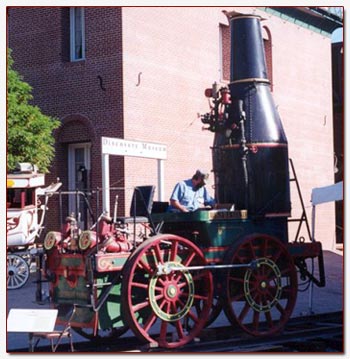
A modern-day replica of the "Best Friend"
News article, The Augusta Chronicle
Monday, 14 June 1993
Historic Train Comes Home
Best Friend is replica of the first locomotive
to offer passenger and freight service in U. S.
Charleston, S. C. — In 1830, city fathers named their new locomotive "The Best Friend of Charleston" because they hoped it would stoke the economy by opening a new trade route. Today, a full-scale reproduction of the historic train is ready to return permanently to the city, where it will boost a different part of Charleston's economy: tourism.
The Best Friend, owned by Norfolk Southern Corp., is a nearly exact copy of the first locomotive to offer regular passenger and freight service in the United States. It was also the first train to carry U. S. mail and to move troops toward a war zone. "For Charlestonians, it's an important reminder of a wonderful part of our history," said Mayor Joseph P. Riley Jr., who spent six years negotiating the train's return.
The train's history began in 1821, when an article in the Charleston City Gazette suggested a rail link between Charleston and Augusta. At the time, the city's economy was slumping. The Ashley and Cooper Rivers don't extend far inland, limiting water transportation to the state's prospering interior.
While cotton production rose 107 percent between 1820 and 1830, exports through Charleston rose only 43 percent. The South Carolina Canal and Railroad Co. formed to build a new railroad that could reroute cotton from the Savannah River to Charleston's port.
The company considered using horses to pull the cars, but board member Ezra Miller, a Charleston mechanic who had studied England's more advanced railroads, thought of a better way, said John M. LeCato of the Charleston chapter of the National Railroad Historical Society. To reduce the risk for the fledgling company's stockholders, Mr. Miller personally commissioned construction of the Best Friend locomotive from a New York company.
Mr. Miller brought the new train to Charleston in October 1830, hoping to convince his fellow board members to buy the $4,000 six-ton [sic] machine once described as "half salamander, half alligator." The deal was completed two days before its first run—Christmas Day 1830. About 140 people climbed aboard at Line Street and traveled six miles to Dorchester Road, as far as the tracks had been laid.
The very next day, the railroad began making four daily runs between Line Street and Dorchester Road. In 1833, the Canal and Railroad Co. had extended its tracks 136 miles inland to Hamburg, a new town across the Savannah River from Augusta. The tracks, after leaving Charleston, also passed through Beesville, Summerville, Branchville, Midway, Blacksville, Windsor, Aiken, then to Hamburg.
At the time of its completion, the South Carolina Canal and Railroad was the longest railroad in the world, and more than twice as long as any other in the United States.
|